
Smart Watches
Smartwatches Are Becoming the New Social Status Symbol — Here’s Why


Have you ever noticed how quickly people notice a smartwatch the moment someone lifts their wrist? It’s subtle, but it sends a message. The simple act of glancing at your wrist can communicate discipline, awareness, confidence, and even status. In modern society, smartwatches have quietly become more than just gadgets—they’re social signals. They reveal what we value, how we manage time, and how connected we want to be. And even if someone has never consciously thought about it, they can instantly sense professionalism and lifestyle cues the moment they see that familiar digital glow on a wrist.
Today, young adults, college students, employees, and families use smartwatches not only for tracking fitness or receiving notifications but also because of what the device represents. In a world full of distractions, smartwatches show you care about your time. In a culture that values productivity, they signal responsibility. In conversations where phone checking might look rude, a discreet wrist glance feels respectful. These small signals influence how people see you and how you see yourself.
In this blog, you’ll learn how smartwatches function as modern social signals, why they change social perception, how they differ from traditional watches, and what they reveal about watch wearers vs non-wearers. Whether you’re thinking of buying your first smartwatch or simply curious about how they shape social behavior, this guide will help you understand the deeper meaning behind today’s wrist tech.
Why Smartwatches Became Social Signals?
Smartwatches didn’t become “signals” overnight. People naturally read meaning into everyday objects—clothes, accessories, even the devices we carry. A smartwatch combines all three: fashion, technology, and behavior. This makes it a strong symbol of identity and lifestyle.
Symbol of Organization and Time Awareness:
When someone wears a smartwatch, others often assume they value efficiency. The device communicates:
- I track my schedule
- I value my time
- I stay updated without distraction
Even though not every wearer is extremely organized, the symbol itself creates that perception.
Representation of Health and Fitness Lifestyle:
Most smartwatches highlight fitness features—heart rate monitoring, step counting, sleep analysis, calorie tracking. So wearing one quietly signals:
- I care about health
- I monitor my habits
- I strive for improvement
You don’t need to say it—people automatically assume it.
Indicator of Modernity and Tech Awareness:
Smartwatch wearers often look like people who stay updated with trends. The device itself communicates that the wearer is familiar with modern technology, possibly more adaptive, confident, and future-forward.
How Smartwatches Shape Social Perception?
Smartwatches subtly influence how others interpret your actions, especially in social or professional environments.
Less Distracting Than Phones:
Pulling out a phone has social stigma. It sometimes signals boredom or lack of interest. A quick wrist glance, however, communicates:
- I’m still present
- I’m just checking something small
- You have my attention
This builds trust in conversations.
Professional Presence:
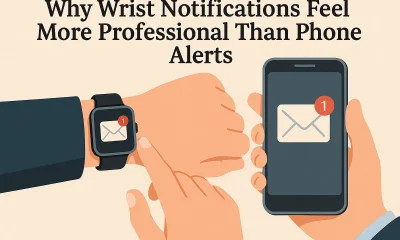
In meetings, classrooms, presentations, and interviews, smartwatches allow you to stay informed without appearing unprofessional. This gives the wearer a polished and composed appearance.
Signals Self-Control:
Phone notifications often pull you into apps. Smartwatch notifications feel lighter and more intentional. People notice when you check your phone too often. But wrist checking feels controlled and purposeful.
Smartwatch Wearers vs Non-Wearers
This comparison isn’t about superiority—it’s about behavioral tendencies and social perception.
Smartwatch Wearers Often Appear To:
- Prioritize time management
- Be more structured with daily routines
- Respond faster but with less distraction
- Care about fitness or wellness
- Be more tech-inclined
- Carry a “minimalist” approach to digital life
Non-Wearers Often Appear To:
- Prefer traditional habits
- Rely more on phones
- Have fewer digital interruptions
- Value simplicity
- Stay unplugged from constant alerts
Again, these are not absolute truths—they are perceived signals, which heavily influence social dynamics.
The Social Psychology Behind Smartwatch Signaling:
Smartwatches communicate identity because humans interpret objects as part of a person’s character. This concept is based on symbolic interactionism, a psychological theory that explains how people form impressions based on visible symbols.
Instant Impression Formation:
When someone sees a smartwatch on your wrist, their brain automatically processes assumptions about who you might be. These assumptions can include:
- You are time-conscious
- You are health-conscious
- You prefer smart efficiency
- You enjoy structure
- You are connected but not consumed by technology
These impressions influence first impressions in jobs, relationships, or social interactions.
Behavior Reinforcement:
Wearing a smartwatch also affects the wearer’s own habits. Many people report feeling more responsible or organized once they start wearing one. The device becomes a reminder of their goals, daily steps, notifications, or activities.
This creates a loop:
You wear the smartwatch → people see you differently → you behave more intentionally → the device becomes a part of your identity.
While they are not luxury items like designer watches, smartwatches still signal status in subtle ways.
They Represent Access to Technology:
A smartwatch suggests the wearer invests in lifestyle tech. It shows they value convenience, productivity, and modern functionality.
They Blend With Fashion:
Smartwatches have become stylish accessories. Custom straps, faces, and designs allow people to personalize their identity through the device—another form of signaling.
They Connect Health, Tech, and Personality:
Few accessories combine so many aspects of life. That’s why a smartwatch says more about someone than a traditional watch or phone alone.
Why Smartwatches Matter in Today’s Social World?
We live in a fast-paced, always-connected society. Smartwatches help people stay socially aware:
- They allow subtle communication
- They prevent rude interruptions
- They support time management
- They enhance appearance in professional settings
- They signal personal discipline
Whether you’re a student handling classes, a parent managing schedules, or a professional navigating meetings, smartwatches help you appear more composed and confident.
Conclusion:
Smartwatches are more than digital accessories—they are modern social signals that reflect lifestyle, discipline, awareness, and identity. They communicate organization, health consciousness, and professionalism without saying a word. In a world full of distractions, a smartwatch helps you stay connected in a controlled, subtle, and socially respectful way. If you want to appear more intentional with your time, more focused in conversations, and more aligned with modern habits, a smartwatch can be a powerful tool. Start today, explore the options available, and experience how this small device can transform the way others see you—and the way you see yourself.

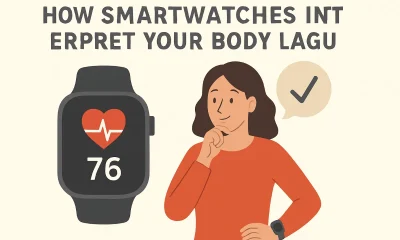

Have you ever wondered how your smartwatch “knows” when you’re stressed, excited, walking, sitting, sleeping, or even feeling tense? It almost feels like the tiny device on your wrist can read your body language—because in many ways, it actually can. And yet, most people who buy smartwatches have no idea how these devices interpret signals from their body.
If you’re one of them, don’t worry—you’re not alone. Many first-time smartwatch users get confused by terms like “motion sensors,” “micro-gestures,” “heart-rate variability,” and “body cues.”
But here’s the good news: you don’t need to be a tech expert to understand how this works. Once you know the basics, you’ll see how smartwatches act like a mini “body language interpreter” on your wrist—collecting signals, translating them, and turning them into clear insights about your daily life. In this guide, you’ll learn exactly how smartwatches interpret your body language, why this matters, and how you can use this powerful data to make better lifestyle decisions.
What Does “Body Language Interpretation” Mean in Smartwatches?
In human communication, body language includes gestures, posture, movement, facial expressions, and physiological signals. A smartwatch can’t see your face or posture, but it can detect micro-movements, muscle tension patterns, stress responses, heart rhythm changes, and activity patterns that reveal what your body is expressing. Think of it as a digital version of intuition—it senses patterns you don’t even notice in yourself. This is done through built-in sensors like accelerometers, gyroscopes, optical heart monitors, skin temperature readers, and even advanced motion-tracking algorithms. These sensors work together to convert your physical behavior into digital data.
How Smartwatches Read Your Movements:
Most body language cues come from movement, and smartwatches use two main sensors to track it:
• Accelerometer – Measures how quickly your wrist moves
• Gyroscope – Detects rotation and orientation
Together, these sensors can interpret actions such as:
• Are you walking energetically or slowly?
• Are your gestures rapid, calm, shaky, or tense?
• Are you sitting, running, or fidgeting?
• Are you lifting weights or typing on a keyboard?
These tiny motions reveal a surprising amount of your emotional and physical state. For example:
• Rapid, restless hand movements may indicate stress or anxiety
• Smooth, fluid movement may indicate relaxed confidence
• Slow, heavy motion may suggest fatigue
This isn’t guesswork—companies like Apple, Fitbit, and Garmin use machine-learning models trained on millions of movement samples to analyze these details.
How Smartwatches Interpret Your Emotional State?
Your emotions influence your body, and smartwatches track these changes through several biometrics:
• Heart rate – increases with stress or excitement
• Heart-rate variability (HRV) – lower HRV often means tension or fatigue (Harvard Health supports this correlation)
• Skin temperature – rises or falls with stress, sleep cycles, or hormonal shifts
• Blood oxygen levels – linked to breathing and physical strain
When the sensors notice irregularities—such as a sudden heart-rate spike while you’re sitting—they interpret it as “stress activation.” This is why your watch may prompt you with notifications like “Take a moment to breathe” even before you realize you’re stressed. It understands the body’s subtle signs before your mind catches up.
How Smartwatches Interpret Micro-Gestures and Hand Movements?
Micro-gestures are tiny, unconscious movements your hand makes when you’re feeling specific emotions or doing certain tasks.
Smartwatches can interpret micro-gestures like:
• Lifting the wrist quickly = eagerness or attention
• Repeated tapping or shaking = restlessness
• Slow controlled lifts = calm focus
• A sudden stop in movement = stress or surprise
Some advanced watches like Apple Watch Series 9 and Samsung Galaxy Watch 6 can even recognize hand-pinch gestures or fist squeezes. These micro-movements help the watch understand behavior patterns like:
• Are you in a rush?
• Are you nervous?
• Are you focused?
• Are you multitasking?
How Smartwatches Interpret Your Daily Behavior Patterns?
A smartwatch doesn’t just look at single signals—it looks at patterns. This is where real “body language interpretation” happens.
Here are examples of patterns it interprets:
• Your walking speed = energy level
• Your sedentary time = posture pattern
• Your sleep interruptions = stress or tension
• Your step rhythm = mood and confidence
• Your wrist temperature cycle = emotional variation or fatigue
• Your breathing rate = nervousness or calmness
For example, a 2020 Stanford study found that wearable data could detect stress patterns with high accuracy based on heart-rate variability and movement fluctuations. This means your watch isn’t just reading isolated numbers—it’s analyzing your behavior as a whole.
How Smartwatch Data Helps You Understand Yourself Better?
Once the smartwatch interprets your body language, it presents the insights in simple ways:
• Activity reminders
• Stress alerts
• Sleep scoring
• Recovery suggestions
• Breathing exercises
• Daily readiness ratings
These insights can help you:
• Spot emotional triggers
• Identify unhealthy routines
• Improve posture and movement
• Create better sleep habits
• Reduce stress
• Track fitness progress
• Understand how your body reacts throughout the day
How Smartwatches Predict Your Behavior?
Because of machine learning, smartwatches can even predict behaviors such as:
• When you might get stressed
• When your energy will dip
• When you need to move
• When your mood is likely to improve after exercise
• When your sleep quality will decline
This turns your watch into a personal coach that understands your body language before you do.
Are Smartwatches Accurate in Reading Body Language?
They’re not perfect—but they are surprisingly reliable when multiple sensors work together. Accuracy improves with:
• Consistent wearing
• Clean sensor contact
• Updated algorithms
• Stronger lighting for optical sensors
And while they don’t “read emotions” the way humans do, they interpret the physical signs that emotions leave behind—often more accurately than we notice ourselves.
Is It Safe to Let Smartwatches Read Your Body Language?
Yes—because they don’t “see” you. They only collect biometric signals you naturally produce, like heart rate and movement. However, always check privacy settings, especially if you use third-party fitness apps.
Conclusion:
Smartwatches may look simple, but they are incredibly advanced when it comes to interpreting your body language. They understand your movement, stress levels, emotions, energy patterns, and even your micro-gestures by analyzing biometric signals you produce every second of the day. This means you get real, actionable insights that help you make better lifestyle decisions—whether your goal is better sleep, more productivity, improved emotional balance, or smarter fitness habits. The more you wear your smartwatch, the better it understands you, and the more value it provides. If you’re ready to know your body in a way you never have before, start paying attention to the signals your smartwatch is already giving you. Your body speaks all day long—now you finally have a tool that listens.

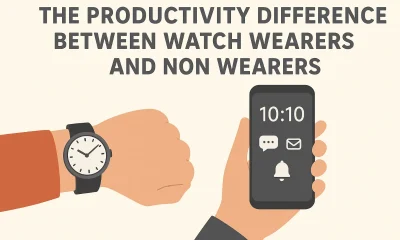
Have you ever wondered why some people seem more organized, punctual, and productive than others—even when they have the same number of hours in a day? It’s easy to assume they have better habits or stronger discipline. But what if a simple accessory, something as basic as a watch, plays a much bigger role than we expect? Whether it’s a traditional wristwatch or a modern smartwatch packed with data and tracking features, watch wearers often enjoy a level of structure and awareness that non-wearers struggle to maintain.
If you’re someone who doesn’t wear a watch, you might rely heavily on your phone to check the time, track reminders, or monitor your day. And while that seems convenient, research shows that smartphones can interrupt your focus far more than you think. A 2014 study by Loughborough University found that people who check the time on their phones are significantly more likely to get distracted by notifications, reducing their productivity by up to 20%. Meanwhile, watch wearers avoid this entire distraction loop by simply glancing at their wrist.
In this blog post, you’ll learn exactly how the productivity levels differ between watch wearers and non watch wearers, backed with psychology, real data, and relatable everyday scenarios. You’ll also discover how smartwatch data—like steps, sleep tracking, reminders, and heart-rate insights—further boosts productivity for modern users. Whether you’re a student, a busy employee, or someone trying to improve your personal efficiency, this guide will give you a practical, clear, and honest understanding that helps you decide whether a watch (especially a smartwatch) is worth adding to your daily life.
Why Watch Wearers Tend to Be More Productive?
The biggest advantage watch wearers have is instant access to time. Time awareness builds discipline, and discipline builds productivity. Think about it: every time you reach for your phone to “just check the time,” there’s a high chance you’ll see a message, reel, or notification. A simple 2-second action suddenly becomes a 10-minute scroll.
Psychologists call this a micro-distraction loop, and it resets your brain’s concentration every time it happens. Watch wearers avoid this entirely. Their focus remains on the task at hand.
Key Productivity Benefits of Watch Wearers:
- They track time without unlocking a phone
- They maintain better awareness of deadlines
- They reduce digital distractions
- They build stronger habits around punctuality
- They feel a subtle psychological pressure to stay on track
This tiny shift—checking time on the wrist instead of the screen—compounds throughout the day, creating a noticeable productivity difference.
The Rise of Smartwatch Data and Why It Boosts Productivity Even More
Traditional watches help with time awareness, but smartwatches take productivity to a completely different level. They don’t just tell the time—they deliver information, instructions, and reminders without pulling you into a distracting digital world.
According to a 2020 study published by The Economist Intelligence Unit, smartwatch users reported a 30% improvement in task management and daily accountability. The reason? Smartwatches offer micro-notifications that don’t disrupt focus the way phones do.
How Smartwatch Data Enhances Productivity?
- Activity tracking keeps your body energized, which improves cognitive performance
- Sleep insights help you understand why some days feel slower or more productive
- Reminders and alerts notify you quietly without pulling you into apps
- Focus modes limit unnecessary interruptions
- Calendar sync keeps students and professionals on schedule
The best part? These features work in the background. You don’t have to “remember” to check productivity tools—they come to you.
Difference Between Watch Wearers and Non Wearers
Let’s break down the most important distinctions.
Time Awareness
Watch wearers stay more conscious of time passing. They naturally structure their day better. Non wearers often lose track of time because they rely on phones and digital cues.
Distraction Levels
Non wearers get exposed to phone distractions 50–60 times per day, according to a 2022 survey by Reviews.org. A simple glance becomes an accidental scroll. Watch wearers avoid this loop entirely.
Punctuality and Responsibility
Studies show that people who wear watches are more punctual and responsible. A 2015 study by the University of Glasgow found that watch wearers are generally more conscientious—a personality trait linked to productivity and reliability.
Health and Habit Tracking
Smartwatch wearers benefit from step goals, stand reminders, heart-rate checks, and sleep analysis. These tiny nudges help build better habits. Non wearers rarely track health unless they do it manually.
Task Management
Smartwatch wearers receive task reminders in a subtle way. Non wearers depend on phone notifications that can easily be dismissed or missed.
Do You Really Need a Watch to Be Productive?
Not necessarily, but it makes the process much easier. Wearing a watch gives you a tool that supports your productivity instead of distracting you. It’s like having a mini personal assistant constantly on your wrist—quiet, focused, and always ready.
If you’re someone who:
- Struggles with time management
- Gets distracted easily
- Misses deadlines
- Wants to improve daily discipline
- Needs reminders without phone addiction
…then wearing a watch (especially a smartwatch) can genuinely transform your daily routine.
Why Non Wearers Often Feel Overwhelmed?
When you depend entirely on your phone, you unintentionally give it permission to control your time. Every beep pulls you away from your priorities. Every scroll steals minutes. Over time, this creates a feeling of being behind, even when you’ve been “busy” all day.
Non wearers usually experience:
- More interruptions
- More mental fatigue
- Poorer time estimation
- Difficulty sticking to routines
- Emotional overload from digital noise
Productivity isn’t about working harder—it’s about managing attention. And watches help protect your attention.
Conclusion:
The productivity difference between watch wearers and non-wearers is bigger than most people realize. Watch wearers stay more focused, more time-aware, and more consistent in their habits. Smartwatch users take this advantage even further with data-driven insights that support sleep, movement, reminders, and daily structure. If you’re someone who wants to reduce distractions, boost your efficiency, and gain control over your day, wearing a watch is one of the simplest steps you can take.
Start small. Start today. Even one change—like checking the time on your wrist instead of your phone—can create a ripple effect that transforms your productivity, your habits, and your confidence.

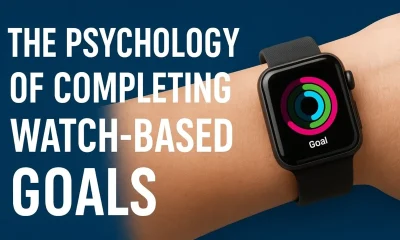
Have you ever felt a strange satisfaction when your smartwatch rings to tell you, “Goal achieved,” or when your activity ring finally closes for the day? That tiny vibration feels like a personal victory, even if it’s just hitting 5,000 steps. Now compare that to days when you rely only on your phone or your memory to track goals. Most people forget, delay, or lose motivation before the day even ends. This difference isn’t accidental—it’s psychological.
Watch-based goals, whether on a smartwatch or even a simple habit-tracker on a traditional watch, are built on science. They tap into your motivation system, your reward pathways, and your brain’s natural craving for visual progress. Many people don’t realize that a simple device on your wrist can shape your behavior more effectively than a phone ever could. If you’re someone who struggles to stay consistent with fitness, time management, or daily routines, understanding the psychology behind watch-based goals can genuinely change your life.
In this blog post, you’ll learn why watch wearers tend to stick to goals more consistently than non wearers, how smartwatch data strengthens motivation, and what makes these tiny reminders so powerful. You don’t need any prior knowledge—this guide explains everything in simple, honest, and relatable language so you can start using watch-based goals to improve your productivity, health, and daily habits.
Why Watch-Based Goals Work: The Psychology Behind Them?
Watch-based goals work because they use behavioral cues, instant feedback, and micro-motivation triggers. These are tiny psychological signals that your brain responds to without much effort.
The first element is visibility. When a goal is visible on your wrist all day—in the form of progress bars, rings, step counts, or reminders—it stays in your awareness. According to a 2021 study by the American Psychological Association, visible goals increase completion rates by nearly 40%.
The second is immediate feedback. Every vibration, reward animation, progress update, or “goal completed” alert acts as a micro-reward. These micro-rewards release small amounts of dopamine, which encourages you to repeat the behavior.
The third is tiny accountability. A watch is worn on your body. Your phone is not. This physical closeness creates a behavioral loop: glance → reminder → action → reward. It becomes automatic over time.
How Smartwatch Data Enhances Motivation and Goal Completion?
Smartwatch users have a different experience than traditional watch wearers, because their devices track far more than just time. They track steps, calories, heart rate, sleep, focus time, and even stress levels. These metrics create a 360-degree view of your daily habits.
Here’s how smartwatch data strengthens goal completion:
- Real-time progress keeps motivation alive throughout the day
- Calorie and step tracking ties movement to visible results
- Sleep analysis explains energy levels and keeps you consistent
- Stress monitoring helps manage emotional triggers
- Move reminders gently nudge you before you fall off track
- Gamification (rings, badges, streaks) encourages healthy competition with yourself
A 2020 report by Stanford University found that people who track health metrics with wearable devices increase their activity levels by 27% on average. Not because the watch makes them fitter, but because the watch makes them more aware.
Difference Between Watch Wearers and Non Wearers in Goal Completion
There is a significant psychological and behavioral gap between people who wear watches and those who rely on phones to track goals.
Attention and Focus
Watch wearers check time or progress without distractions. Non wearers check on their phone and often lose focus due to notifications, messages, and apps pulling attention.
Consistency
Watch wearers get multiple small reminders throughout the day. Non wearers only remember goals when they open apps intentionally—which many forget to do.
Emotional Motivation
Smartwatch feedback provides emotional satisfaction: rings closing, step goals completing, sleep improving. Non wearers rarely experience these micro-rewards.
Habit Formation
Watch-based goals create daily structure. Non wearers depend on willpower, which is inconsistent and drains over time.
Decision Fatigue
Watch wearers receive automatic suggestions like “Time to stand” or “Short walk recommended.” Non wearers must consciously decide what to do next.
Why Watch Wearers Achieve More Goals: The Habit Loop Effect:
The secret lies in a behavioral model called the Habit Loop, popularized by Charles Duhigg and backed by neuroscience research.
The loop has three parts:
- Cue
- Routine
- Reward
Smartwatches provide all three:
- Cue: vibration or visual reminder
- Routine: movement, breathing exercise, step tracking
- Reward: immediate feedback, ring progress, dopamine boost
Because this loop repeats daily, it becomes automatic. Non wearers rarely experience this building process because their cues are weak and easily forgotten.
Watch-Based Goals and the Science of Immediate Rewards
Humans naturally respond better to small, instant rewards than large, delayed rewards. Psychologists call this instant gratification bias. Smartwatches use this bias to help you—not harm you.
Here’s how watch-based goals provide instant gratification:
- A ring closes → reward
- A vibration signals progress → reward
- A badge appears → reward
- A streak continues → reward
These rewards are tiny but powerful. Over time, they build a habit that feels satisfying instead of forced.
How to Make Watch-Based Goals Work for You:
If you’re new to smartwatches or watch-based goal tracking, start small.
Helpful steps include:
- Set only one primary goal for the first week
- Keep the goals achievable to build confidence
- Use automatic reminders
- Track your sleep to understand energy patterns
- Customize alerts so they don’t feel overwhelming
- Review progress at night to close the psychological loop
The goal is not perfection—it’s awareness and consistency.
Why Non Wearers Often Struggle With Goal Completion:
Non wearers face several challenges that reduce their ability to follow through:
- They rely on memory instead of reminders
- Their goals are not visible
- Their motivation depends on willpower
- Their phone distracts them when checking progress
- They lack instant feedback
- Their routine feels disconnected from their goals
Without physical cues or progress trackers, goal completion becomes harder and less satisfying.
Conclusion:
The psychology of completing watch-based goals is deeply rooted in how our brains respond to visibility, reminders, and rewards. Watch wearers—especially smartwatch users—enjoy stronger motivation because their goals stay in sight, in mind, and close to their body. Smartwatch data enhances this process even more by providing insights that strengthen consistency. Whether you want to build better habits, stay productive, or improve health, adopting watch-based goals is one of the simplest ways to transform your daily routine. Start today, set one small goal on your watch, and let your progress guide you toward a more disciplined, confident, and motivated version of yourself.

Honor Win & Honor Win RT: Simple Overview for Everyone

Xiaomi 17 Ultra Launched: Powerful Camera, Premium Design, and Top Performance

Realme 16 Pro Key Specifications Revealed Ahead of Its Official Launch

How Smartwatches Read Your Body Language — The Secret Behind It

Watch Wearers vs Non-Wearers — The Productivity Gap No One Talks About

The Psychology Behind Completing Watch Goals — Why It Feels So Addictive

Why Wrist Notifications Feel More Professional Than Phone Alerts

Smartwatches Are Becoming the New Social Status Symbol — Here’s Why

When Is It Okay to Look at Your Smartwatch? The Answer Might Shock You

Why Smartwatches Are Becoming the New Favourite Gift?
-

 Luxury Watches11 months ago
Top 10 Most Expensive Watches in India – Is Buying a Rs.1 Crore Watch Worth It?
-

 Smart Watches11 months ago
16 Best Smartwatches UNDER ₹1000 – Budget Smartwatch in India
-

 Luxury Watches10 months ago
Top 10 Ultra Luxury Watch Brands Worn by Billionaires
-

 Luxury Watches11 months ago
GST on Luxury Watches in India: A Complete Guide
-

 Smart Watches11 months ago
The Best Smartwatches Under ₹2000 in India for 2025: Your Ultimate Guide
-

 Luxury Watches11 months ago
Best Brand Watches for Men in India (2025)
-

 Smart Watches9 months ago
Fire‑Boltt Ring X Features: BT Calling, Battery, Display and Price
-

 News12 months ago
Redmi Watch Move: Features, Specs, Price, and Everything We Know So Far